



Employment Law
DOL Clarifies When a Nonprofit's "Employee" Can Sometimes Be a "Volunteer," Too
10.20.2026 | Linda J. Rosenthal, JD
A few months ago, New York Times reporters Emily Badger and Alicia Parlapiano nailed it when they described the Sisyphean dilemma faced by dedicated public servants and tireless charitable-sector workers each and every day since January 20, 2025.
“President Trump has tried to withhold billions of dollars in federal funding to coerce states, punish opponents, remake programs and impose his views. His targets have repeatedly sued to stop him, and the courts have repeatedly rebuked him — only for the president to try again and again.” Trump Keeps Finding New Ways to Withhold Money Even After 198 Lawsuits (March 3, 2026).
It isn’t supposed to be like this.
Recall how Edmund Randolph, Virginia’s representative to the Constitutional Convention, successfully reassured his colleagues that “the new office of the President need not be feared.” The reason, he told them, is because “[h]e can handle no part of the public money, except what is given him by law.”
“Since Day One” of his second term, “the president and his cabinet allies have been on a scorched-earth rampage to reduce the size of the federal government through drastic agency downsizing as well as huge cuts in federal grants and contracts.” See Gov’t Overreach At 18 Months (July 30, 2026) FPLG Blog.
To be sure, shrinking the government footprint is part of the Project-2025 years’-long wish list, but it’s only a first step. That 900+-page manifesto published ahead of the 2024 presidential election reveals a blueprint much grander – and more breathtakingly anti-constitutional – than merely taking control of the nation’s “purse strings.”
It hasn’t hurt this president’s chances of Project-2025-scale successes that he has achieved control of a docile Department of Justice and has had 5-½ years to appoint loyalist judges, particularly at the appellate level. See Trump’s ‘Superstar’ Appellate Judges Have Voted 133 to 12 in His Favor (January 11, 2026) Mattathias Schwartz and Emma Schartz, The New York Times [“President Trump promised to fill the appeals courts with ‘my judges.’ They have formed a nearly united phalanx to defend his agenda from legal challenges.”]
And the Supreme Court majority has also played along. In the first few months of the Trump 2.0 administration, the opposition racked up temporary restraining orders and preliminary injunctions left and right. That’s when the president’s favorite justices swooped down and plucked up several lawsuits for “special” attention. See Litigating in the Shadows: Federal Funding and the Supreme Court (December 2, 2025) John Lewis, Lawfare [“The Supreme Court’s willingness to stay lower court rulings against the Trump administration’s policies on the so-called shadow docket has frustrated litigants and judges alike.”]
This development has caused so much anguish and anger among the nation’s jurists that they have broken their traditional code of silence. See Federal Judges, Warning of ‘Judicial Crisis,’ Fault Supreme Court’s Emergency Orders (October 11, 2025) Mattathias Schwartz and Zach Montague, The New York Times [“Dozens of sitting judges shared with The Times their concerns about risks to the courts’ legitimacy as the Supreme Court releases opaque orders about Trump administration policies.”]
The shock-and-awe 2.0 blitz began shortly after noon on Inauguration Day. By sunset, twenty-six brand-new executive orders on an extravagant range of topics had been lobbed at the American public from the Oval Office.
These directives kept on coming day after day, enlarging the target list of people, organizations, causes, and (blue) jurisdictions in the crosshairs. The sheer volume is staggering – and scary. See, for example, the chart produced by the National Council of Nonprofits titled Executive Orders Affecting Charitable Nonprofits (updated as of July 28, 2026). Currently 36 pages long, it’s packed with lawsuit after lawsuit of maddeningly similar case names – for instance, “New York v. Trump.”
This NCN executive-order litigation tracker is in addition to several other Trump-related lawsuit lists we had already mentioned in our July 30th post.
In Federal Grants: A Constitutional Primer, Part One (August 6, 2026) FPLG Blog, we explained a bit about how the Founding Fathers came to adopt a first-of-its-kind constitution with safeguards against all sorts of presidential overreach including attempts at seizing control of the nation’s “purse strings.”
These statesmen had learned in school about centuries of out-of-control English monarchs. They had seen first-hand how King George III was, at best, selective in adhering to the new order established by the Glorious Revolution of 1688: that is, the intentional shift of power out of the palace and into Parliament.
These early American leaders also oversaw an ill-fated swing too far in the other direction. The Articles of Confederation were unworkable, particularly because the federal government had no power to raise money and the individual states were only encouraged – but not required – to contribute to the coffers of the new central government.
Later, as drafters of the Constitution of the United States, these same men settled on a middle-ground they hoped would be “just right.”
“It wasn’t easy,” we explained in our August 6th post, for the drafters “to achieve a consensus about the size and power of the central government. But they came to an agreement with two prongs. See Intro.7.1 Overview of Basic Principles Underlying the Constitution, Constitution Annotated, constitution.congress.gov.
First, there would be a “separation of powers” at the federal level, with three co-equal branches of government.
Second, the most extensive powers would be in the legislative branch. “When the Framers gathered in Philadelphia to draft the new Constitution, there was no question that Congress would be granted the power to tax, spend, and appropriate funds.”
“These governing pillars are firmly rooted in the Constitution of the United States as drafted and ratified in the late 1780s. They have been confirmed repeatedly since then through the present day.”
“Well – that is, until almost the present day,” we added in our last post: Federal Grants: A Constitutional Primer, Part One (August 6, 2026).
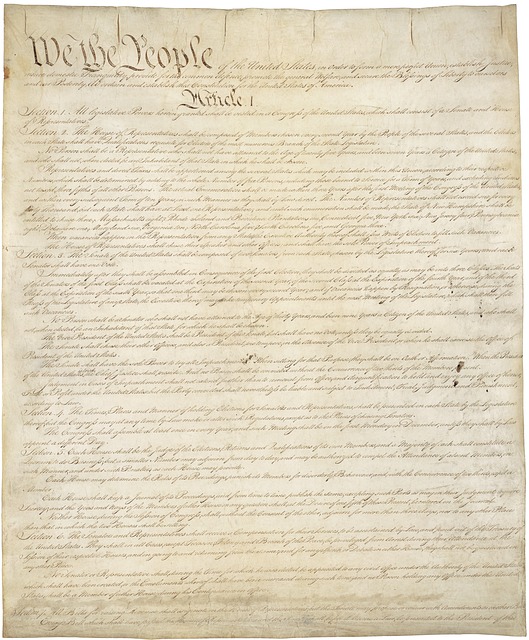
The Constitution of the United States is a surprisingly “short document that, with its current amendments, contains only a little more than 7,500 words” and “has grown very little since its initial enactment.” (That’s not much more than about four of my chunkiest blog posts!)
There is the well-known Preamble, followed by the seven Articles included at the time of ratification in the late 1780s, and concluding with the 27 amendments to date.
“…The Constitution of the United States broadly embraces three interrelated but distinct concepts that define American democracy.” They are: separation of powers, federalism, and protection “of certain individual rights from government interference.”
“Separation of powers is a doctrine of constitutional law under which the three branches of United States government (executive, legislative, and judicial) and their duties, are kept legally separate.” See Intro.7.2 Separation of Powers Under the Constitution, Constitution Annotated, constitution.congress.gov
Despite its importance, the phrase “separation of powers” does not appear at all in the Constitution’s text.
In any event, what is included in our Constitution is the affirmative directive for an express “…division of power among the three branches of government.” It is a foundational concept of American government and “reflects the Framers’ views that the Federal Government’s power should be limited and diffused among the three branches.”
It is also sometimes called a “system of checks and balances” because It creates “clear boundaries” by keeping “the core functions of lawmaking, enforcement,and adjudication separate.” The doctrine “gives each branch ways to limit the actions of the other two branches. For example, the President can veto a bill, Congress can override that veto, and courts can declare laws unconstitutional.”
These checks and balances are said to “thwart tyranny” because “[s]preading power stops any individual or group from gaining total control.”
That – at least – is how it’s supposed to work.
What is the origin of the “separation of powers” concept? A French nobleman named Charles Louis de Secondat, Baron de Montesquieu (1689-1755) “was one of the most influential legal theorists and political philosophers of the 18th century. His ideas about the separation of powers and checks on the power of the executive had a profound impact on the architects of the American constitution.”
He coined “the term ‘trias politica’ or ‘separation of powers’” in his book, The Spirit of Laws, lauded as “one of the great works in the history of political theory and jurisprudence.” Under the model described in The Spirit of Laws, “the political authority of the state is divided into legislative, executive and judicial powers. The purpose is to effectively promote liberty.”
See also The Federalist No. 48 (James Madison): “[T]he accumulation of all powers, legislative, executive, and judiciary, in the same hands, whether of one, a few, or many, and whether hereditary, self-appointed, or elective, may justly be pronounced the very definition of tyranny.”]
Before we move on to the next “primer” topics – including most particularly discussions about Articles I, II, and III of the Constitution as well as the legal force and effect of presidential executive orders – it’s important to acknowledge the “elephants in the room.”
In the current era of political turmoil and chaos, there are critical signs of deep flaws in the traditional separation-of-powers doctrine.
See, for example: Trump v. United States and the Separation of Powers (online ed.)(February 3, 2025) Professor Shalev Gad Roisman pennlawreview.com . He argues that the majority’s opinion in that deeply controversial presidential immunity case from 2024 reveals “fatal limitations in the dominant form of separation-of-powers analysis on the Supreme Court today: separation-of-powers formalism.”
See similarly: The Uncertain Future of the Separation of Powers (August 24, 2025) Catherine Lewis, interviewing Professor Peter M. Shane, The Regulatory Review. They examine “the implications of recent U.S. Supreme Court rulings and Trump Administration executive actions for the separation of powers.”
There are also significant cracks in “federalism,” another foundational concept of our governmental system under the United States Constitution. We’ll discuss that briefly, before diving into the key points of this constitutional primer on federal grants.
For instance, we’ll take a quick peek at “The Taxing Clause” of Article I, Section 8, Clause 1; [“The Congress shall have Power To lay and collect Taxes,…”] and at The Appropriations Clause of Article I, Section 9, Clause 7: [“No Money shall be drawn from the Treasury, but in Consequence of Appropriations made by Law.”]
And we’ll also discuss significant presidential restrictions including The Impoundment Control Act of 1974.
– Linda J. Rosenthal, J.D., FPLG Information & Research Director
Sign up to be notified when we publish news and articles that impact nonprofits, social entrepreneurs and philanthropists.